Showing posts with label People. Show all posts

Tuesday, April 3, 2018

10 Richest MMA Fighters in the World 2018

If you’re an MMA fan, have you ever wondered how much your favorite fighters make, and who’s on the list of the richest? Who are the richest MMA fighters in the world?

We’ve put together this ultimate list of the 10 richest MMA fighters in the world and how much they’re currently worth. These numbers have come straight from Forbes and Celebrity Net Worth.

Here are the top 10 richest MMA fighters in the world:

1. Conor McGregor
Net Worth: $85 Million

10 Richest MMA Fighters in the World 2018

Conor McGregor is an Irish professional MMA fighter in the UFC. He’s also one of the most notorious fighters in the MMA, and has become an incredible sensation over the past couple of years.

Funnily enough, the majority of McGregor’s net worth hasn’t come from his MMA fights. It’s actually come from recently making his boxing debut against the one and only Floyd Mayweather.

Conor McGregor is the richest MMA fighter in the world, with an estimated net worth of $85 million.

2. Rorian Gracie
Net Worth: $50 Million

10 Richest MMA Fighters in the World 2018

Rorion Gracie is a Brazilian-American Gracie Jiu-Jitsu Grand Master, writer, publisher, producer, lecturer, and the co-founder of the UFC.

He is one of the few people in the world to hold a 9th degree red belt in Brazilian Jiu-Jitsu, and is known for introducing Gracie/Brazilian Jiu-jitsu to the world.

Rorian Gracie is one of the richest MMA fighters in the world, with a net worth of $50 million.

3. Georges St. Pierre
Net Worth: $25 Million

10 Richest MMA Fighters in the World 2018

Georges St-Pierre is a Canadian mixed martial artist, and a three-time former Welterweight Champion of the UFC. Many consider him to be one of the greatest MMA fighters of all time.

Georges St. Pierre made the list of richest MMA fighters in the world with a net worth of $25 million.

4. BJ Penn
Net Worth: $22 Million

10 Richest MMA Fighters in the World 2018

Jay Dee Penn is an American professional mixed martial artist and Brazilian Jiu-Jitsu practitioner.

Penn has previously won both the Lightweight and Welterweight UFC Championships. Only two other fighters in history have won titles in multiple weight classes.

BJ Penn’s net worth in 2018 is $22 million.

5. Brock Lesnar
Net Worth: $22 Million

10 Richest MMA Fighters in the World 2018

Brock Edward Lesnar is an American professional wrestler and former professional mixed martial artist, and professional American football player.

Lesnar is the former UFC Heavyweight Champion; however he currently wrestles in the WWE. With a net worth of $22 million, he’s proven to be one of the most successful and richest MMA fighters worldwide.

6. Anderson Silva
Net Worth: $18 Million

10 Richest MMA Fighters in the World 2018

Anderson Silva is a Brazilian mixed martial artist and former UFC Middleweight Champion. Silva holds the longest title streak in UFC history with 16 consecutive wins and 10 title defenses.

Anderson Silva is one of the richest MMA fighters in the world with an estimated net worth of $18 million.

7. Fedor Emelianenko
Net Worth: $18 Million

10 Richest MMA Fighters in the World 2018

Fedor Emelianenko is a Russian heavyweight mixed martial artist, sambist, and judoka. He currently competes in the Bellator MMA Championships.

Emelianenko has earned numerous MMA accolades over the years, including the following:
  • Submission/Beatdown of the Year (2008)
  • Knockout of the Year (2009)
  • Heavyweight of the Year
  • Fighter of the Year
  • Fight of the Decade (2000’s)

Fedor Emelianenko’s net worth in 2018 is estimated to be $18 million.

8. Wanderlei Silva
Net Worth: $18 Million

10 Richest MMA Fighters in the World 2018

Wanderlei Silva is a Brazilian mixed martial artist who has competed in Japan’s Pride Fighting Championships and the Ultimate Fighting Championship.

Silva holds the record for the most wins, knockouts, title defenses, and longest winning streak in PRIDE history. He fought in the Middleweight division.

Wanderlei Silva’s net worth is estimated to be $18 million, making him the 8th richest MMA fighter in the world.

9. Randy Couture
Net Worth: $17 Million

10 Richest MMA Fighters in the World 2018

Randy Couture is an American actor, retired United States Army Sergeant, and former mixed martial artist.

Couture fought in the UFC, and won 6 championship titles. As we mentioned earlier in the article; only 3 fighters have ever won titles in multiple weight classes. Randy is one of them, and the other two are Conor McGregor and BJ Penn.

Randy Couture’s net worth is estimated to be $17 million.

10. Tito Ortiz
Net Worth: $15 Million

10 Richest MMA Fighters in the World 2018

Jacob Christopher “Tito” Ortiz is an American retired mixed martial artist. He was a very popular sensation with the UFC crowd, and some of his fights were the most watched of all time on Pay-Per-View.

Tito Ortiz is the former Light-Heavyweight Champion of the UFC, and has a net worth of $15 million. He is one of the richest MMA fighters in the world.

Semoga memberi manfaat.

READ MORE: Great Athletes Who Never Won The Big Title

source: wealthygorilla

Monday, August 1, 2016

10 Hackers Who Wrote the History

In our hit-list, we are presenting the 10 most famous people, which can be described as a hacker. They entered either in computer or telephone systems and used these systems according to their own wishes, due to their knowledge and technical skills.
The top 10 Hackers of the world Who Wrote the History:

1. Konrad Zuse


It all started with Konrad Zuse, the very first computer hacker. He might not be in the literal sense, but no hacker could make a difference without his work at all.

Zuse Z3 has developed the first programmable computer in the world. He actually began with the Z1, which he constructed in the living room of his parents and completed in 1938.

The Z3 was completed in 1941. Often regarded as inventor of modern computer.

2. John “Captain Crunch” Draper


John Draper started hacking computers before they really went up the hill. He implemented the programming language Forth and the first word processor for Apple computers, called “Easy Writer”.

In the 1970s, Draper worked with hacking techniques and was a pioneer of circumvention of technical barriers.

He made ​​the phone – phreaking using the well known Blue Box, so one could make free calls to analog telephones.

At that time the system was controlled by analog tone sequences, with which one could also initiate free long distance or international calls. This hack technique was called “phreaking”.

One of the most important tools for phone hacking is a Pennywhistle from the cereal box of Cap’n Crunch.

Draper developed the Blue Box, a device with which one could produce numerous control sounds of telephone companies.

3. Steve Wozniak


Wozniak is a contemporary of John Draper and knew phreaking as well. After Draper published on a computer club meeting the details of his Blue Box, Wozniak built his own version.

Steve Jobs recognized the market potential of the device and the two Steves started their first company. From the sale of Wozniak HP calculators they gained enough revenue to build the Apple I.

4. Robert Tappan Morris


A graduate student at Cornell University, Robert Morris developed the first computer worm. According to his own statements, he wanted to capture the size of the Internet.

After he set the software on November 2, 1988 free, he infected 6,000 computers -which were then about 10 percent of Internet-connected computers.

Due to a programming error, the worm multiplied excessively and made sure that many computers were overloaded. 1989, Morris was the first to be convicted under the Computer Fraud and Abuse Act of 1986.

5. Mark “PhiberOptik” Abene


Most computers experts probably know Mark Abene,. He had the phone company AT &T. As a member of the hacker group Masters of Deception Abene played often around at the AT & T systems.

Through his hacking skills, he crashed the AT& T system and 60,000 customers remained without a phone for about 9 hours, Abene was quickly identified as the culprit.

The Secret Service confiscated his equipment. AT & T had to later admit that the crash was due to an error. Nevertheless, Abene was convicted and landed for a year in jail.He was the first hacker who was detained.

6. Kevin “Dark Dante” Poulsen


Poulsen led by one of the coolest hacks of all time. All the radio lines of L.A radio station KIIS-FM. This radio station promised the 102nd caller of the program would win a Porsche 944 S2.

Poulsen took over all telephone lines and the transmitter and thus ensured that his call was the right one. The telephone line went out later on during the broadcast.

Later, he went into hiding and was wanted by the FBI. He even landed in the American so called unsolved “File number XY … unsolved.” . 1991 Poulsen was under arrest and numerous offenses against him pleaded guilty.

Later he made a 180-degree turn and worked for the elucidation of many computer crimes.

7. Kevin Mitnick


Kevin Mitnick is probably the most famous hacker in the world. He managed to be the first to get on the FBI’s list of most wanted people in the world. He broke into the systems of Nokia and Motorola.

He hacked the punch card ticketing system of Los Angeles bus system through which he could travel in any bus throughout the state.

Through a phone number given by his friend he hacked DEC (Digital Equipment Corporation) main software.

In 1979, at the age of 16, he hacked a computer for the first time and copied proprietary software. After two and a half years, he was arrested and spent five years in prison. He now runs his own security company.

8. Tsutomu Shimomura


Not all hackers are “evil”. Tsutomu Shimomura made sure that Kevin Mitnick was convicted. He helped and collaborated with FBI to get the famous hacker Mitnick arrested.

In 1994 Mitnick stole some personal files of Shimomura and published them online. Shimomura managed to trace it back to Mitnick. Some authors consider his involvement in Mitnick case/arrest as dubious.

9. Richard Stallman


Stallman was a student and programmer at the MIT Artificial Intelligence Lab. He was already open source and retaliated at MIT against the restriction of computer use in the laboratory. In the university a password-protected computer system was established for students.

He decrypted the passwords and sent to the users in plain text, and proposed to give up the password to again in the future to enable anonymous access.

Later Stallman developed the GPL General Public License and the GNU operating system, a completely free Unix system.

10. Linus Torvalds


Linus Torvalds began his hacking career on an old Commodore VIC-20 and the Sinclair QL, which he greatly improved. On the QL, he programmed his own Text Editor and even a Pac-Man clone named Cool Man.

In 1991, he got hold of an Intel 80386 PC and started working on Linux, which he first published under its own license, but later, under the GNU GPL.

He was the principal force behind the development of Linux Kernel.

Source

Wednesday, June 1, 2016

10 Fascinating Deathbed Confessions

When death is inevitable some people decide it is a good time to confess to things that have burdened them during their lifetime.

Perhaps it is in order to leave the world with a clear conscience or maybe to benefit the living ones they leave behind.

This list contains 10 deathbed confessions and the stories behind them of people who, for whatever reason, decided to reveal their darkest secrets.

10. Naomi Shemer
1930-2004


Confessed to: using a Basque lullaby melody for her song Jerusalem of Gold

Naomi Shemer is one of Israel’s best loved songwriters. The song Jerusalem of Gold was first performed in 1967 at an Israeli song festival shortly before the Arab-Israeli war and describes the Jewish people’s 2000-year longing to return to Jerusalem.

It continues to serve as an unofficial Israeli anthem and is often played at national ceremonies. Shemer spent many years denying claims that she plagiarized a lullaby song and turned it into Jerusalem of Gold.

Then in 2004 after years of angry denials she made her confession to another composer Gil Aldema just days before dying of cancer writing to him, “I consider the entire affair a regrettable work accident – so regrettable that it may be the reason for me taking ill,” she also wrote that she heard a well-known Basque lullaby which “went in one ear and out the other” and the song must have crept into her unwittingly. Aldema said that Shemer had agreed for her secret to be revealed after her death.

Interesting Fact: In 2005 the lullaby Pello Joxepe became known worldwide when it was published that Jerusalem of Gold was based on its melody.

The Spanish singer Paco Ibáñez who performed the song in Israel in 1962 where Shemer first heard it was asked how he felt when he heard Naomi Shemer based most of the melody on the lullaby.

He replied by saying he was honored that she chose to use his melody to use for Jerusalem of Gold. You can listen to the song here performed by Ofra Haza at an Israel concert in 1998.

9. Naaman Diller
1935- 2004


Confessed to: the legendary clock collection heist

In 1983, the costliest theft in Israel’s history saw 106 timepieces worth millions of dollars disappear from a Jerusalem museum.

Included in the timepieces was a pocket watch made for Marie Antoinette which is valued at more than £19m ($30 million).

The case remained unsolved for almost 25 years until 2006 when a Tel Aviv watchmaker told police that he had paid some $40,000 to an anonymous person to buy 40 items including Marie Antoinette’s pocket watch (pictured above).

Forensic experts examined the clocks and detectives questioned the lawyer who negotiated the sale. The trail led to an Israeli woman in Los Angeles named Nili Shamrat who police identified as the widow of Naaman Diller who was a notorious criminal in the 1960s and 1970s.

When Israeli police and US officials arrived at her home to question her they found more stolen clocks.

Shamrat then told the police that her husband who she had recently married confessed to her just before he died that he had committed the heist. He then advised his wife to try and sell his collection after his death.

Interesting Fact: The Marie Antoinette watch was actually self winding and was ordered in 1783 by one of her admirers and was to be made by the famous Swiss watchmakers Abraham Louis Breguet.

The order specified that gold should be used wherever possible instead of other metals and to make it the most spectacular watch possible.

The watch was finally finished in 1827, 34 years after Marie-Antoinette was guillotined and four years after Breguet’s death.

8. Christian Spurling
1901-1994


Confessed to: faking the famous Loch Ness Monster photo

In 1934 a doctor named Robert Kenneth Wilson offered a picture to the Daily Mail newspaper. Wilson told the newspaper he noticed something moving in Loch Ness and stopped his car to take the photo.

Wilson refused to have his name associated with it so the photo became known simply as “The Surgeon’s Photo.” For decades this photo was considered to be the best evidence of the existence of the Loch Ness Monster.

In 1994 at the age of 93 and near death Christian Spurling confessed that the surgeon’s photo taken 60 years ago was a hoax and the mastermind behind it was his Stepfather Marmaduke Wetherell.

In the early 1930s, sightings of the Loch Ness Monster became commonplace, so Spurling’s stepfather who was a big game hunter was hired by the Daily Mail newspaper to investigate.

Wetherell found some huge tracks leading to the lake that he proudly displayed to the press. When the Natural History Museum investigated they quickly discovered that the footprints were a hoax.

Wetherell was humiliated when the newspaper reported this and for being fooled by the prank. For revenge he asked his stepson Chris Spurling who was a professional model-maker to make something that would fool the public.

Spurling started with a toy submarine and then added a long neck and small head. The finished product was about 45 cm long, and about 30 cm high. Wetherell then went down to the lake and took some pictures of the “monster”.

To add respectability to the hoax he convinced Dr. Wilson whom he knew through a mutual friend to develop the photo and sell it to the Daily Mail.

Interesting Fact: This deathbed confession is often mistakenly attributed to Roger Patterson of big foot fame.

(The Paterson Film) Paterson died of cancer in 1972 and in this case swore on his death bed that the footage was authentic and he had encountered and filmed a large bipedal animal unknown to science.

7. Geraldine Kelly
1950-2004


Confessed to: the murder of her husband John Kelly

In 1991, after years of domestic violence, Geraldine Kelly shot and killed her husband and stored his body in a freezer at their home in Ventura, California.

She told her young children that their father died in a car accident. Seven years later when she decided to move back home to Somerville Massachusetts she had the moving company move the freezer with the body inside and drive it across the country to a local storage facility in Somerville.

In 2004, 13 years after the murder Kelly was gravely ill with breast cancer and confessed to her daughter that she had killed her father claiming he abused her for years and then told her where to find his body.

Authorities investigated and found human remains in a locked, unplugged freezer in the storage room. The body was mummified but identified as John Kelly based on distinctive tattoos he was known to have including a panther, a Kewpie doll and a skull. The cause of death was a gunshot to the back of the head.

Interesting Fact: The District Attorney of Somerville said it wasn’t clear if Kelly wanted to unburden herself or if she wanted her children to know so if they found the body they wouldn’t be blamed for it.

6. Tor Hepso
1938-2005


Confessed to: the murder of Torunn Finstad and Sigrid Heggheim

In 1978, Fritz Moen (pictured center above) was 36 when he was arrested for raping and killing 20-year-old Torunn Finstad in Trondheim, Norway.

There was no physical or forensic evidence linking Moen to the crime and no witnesses saw him with Finstad.

Moen was deaf with a severe speech impediment and an interpreter was needed for him to communicate effectively.

Moen was found guilty of the murder and sentenced to 20 years imprisonment. Several years later police claimed that Moen had confessed to the 1976 murder of 20-year-old Sigrid Heggheim.

During the seven interrogations his confession came during the one time in which he did not have the benefit an interpreter.

He was found guilty of this murder as well and sentenced to an additional 5 years in prison. In 1996 after spending 18 years in prison he was released and placed under preventative supervision.

During the next several years Moen’s attorneys tried desperately to clear his name. In 2004 he was acquitted for the murder of Sigrid Heggheim finding that reasonable doubt should have acquitted him in the first place.

Then in December 2005 a convicted felon Tor Hepso confessed at a hospital one day before he died to three nurses and later to the police that he had murdered two women and mentioned the names Heggheim and Finstad.

After Hepso’s deathbed confession was thoroughly investigated Moen was finally exonerated of the murder.

Unfortunately Fritz Moen died of natural causes earlier that year in March and was not alive when he was declared completely innocent of the both crimes.

Interesting Fact: This case was publicly criticized as one of Norway’s most shameful miscarriages of justice.

There is even talk of erecting a bust or statue of Moen in front of the Norwegian Ministry of Justice as a symbol of the responsibilities of the criminal justice system.

5. Henry Alexander
1929-1992


Confessed to: the murder of Willie Edwards

I think most would agree that this confession was too little too late and another example of a miscarriage of justice. In 1957 the body of a 25 year old black man Willie Edwards was washed up on the shores of the Alabama River.

Although there was much suspicion surrounding his death officials stated that decomposition made it impossible to determine the cause of death. In 1976, an aggressive attorney re-opened the Edwards case and four Klansmen were arrested including Henry Alexander.

One of the men gave a sworn affidavit (in exchange for immunity). In the statement the man described how he and three other men beat and forced Willie Edwards to jump off the Tyler-Goodwin Bridge because he said something offensive to a white woman.

Even with one of the men’s sworn testimony, Alabama Judge Frank Embry dismissed the charges because no cause of death was ever established.

He concluded that “merely forcing a person to jump from a bridge does not naturally and probably lead to the death of such person.” In 1992, Henry Alexander now 63 was near death from lung cancer and decided to confess to his wife.

He told her he had things bothering him and said Willie Edwards would not have died if he had not falsely identified him as the one who had offended the white woman.

He then said he and the other Klansmen gave Mr. Edwards a choice to run or jump and didn’t think he would jump. He said. “If he’d a run, they would never have shot him.”

Interesting Fact: After her husband’s confession Mrs. Alexander wrote a letter of apology to Mr. Edwards’s widow.

In the letter she writes “I hope maybe one day I can meet you to tell you face to face how sorry I am. May God bless you and your family and I pray that this letter helps you somehow.”

4. James Brewer
1951-


Confessed to: Killing his Neighbor Jimmy Carroll

In 1977 James Brewer was arrested in Tennessee on suspicion of killing his neighbor in a fit of jealous rage. Brewer jumped bail and fled to Oklahoma where he and his wife began a new life together under the names Michael and Dorothy Anderson.

They became active members of the local church where his wife established a Bible study group. They also have a married daughter and are grandparents.

In 2009, Brewer had a serious stroke and before dying he felt compelled to confess to the crime that had weighed on his conscience for over 3 decades. His wife then called the Police Department to the hospital saying her husband wanted to confess to a murder.

Brewer confessed to his crime with the help of his wife who had to translate due to the effects of the stroke. The only problem with this deathbed confession is that fortunately or unfortunately for Mr. Brewer he didn’t die.

When Brewer was released from the hospital he surrendered to Tennessee authorities and appeared in court with the same lawyer he had almost 32 years earlier when he jumped bail. The picture above shows Mr. & Mrs. Brewer after their arrest.

Interesting Fact: The Pastor of the church where Mrs. Brewer set up a Bible study group, said: “I don’t know what their former life was but I do know they were both dedicated to the Lord. They’ve been in their own prison for 30 years. I think they’ve done their time.”

3. Margaret Gibson
1894-1964


Confessed to: the Murder of William Desmond Taylor

William Desmond Taylor was an actor and a top US film director of silent films in the early days of Hollywood.

When Taylor was shot to death in 1922 it became one of Hollywood’s most famous scandals and mysteries.

In 1964, 42 years after the murder a reclusive old woman living in the Hollywood hill was suffering from a heart attack and summoned her neighbor.

With her recent conversion to Catholicism she asked for a priest to confess but when no Priest was available she began to make her confession to her neighbor.

As she was dying on her kitchen floor she said she was a silent film actress by the name of Margaret Gibson and that she shot and killed a man named William Desmond Taylor.

She is alleged to have been involved romantically with Taylor but a motive as to why she killed him was never mentioned. Taylor’s murder remains officially unsolved however the one thing that stands out is that Gibson had absolutely nothing to gain by her confession.

Another revealing fact that should be mentioned is the neighbor that witnessed Gibson’s confession said his mother (who was a friend of Gibson’s) later said that when they were watching a TV piece on the Taylor murder she became hysterical and blurted out that she’d killed him.

Interesting Fact: In the 1950 film Sunset Boulevard, the name Norma Desmond is a reference to both Taylor’s middle name and one of his actress friends Mabel Normand.

You can watch a silent movie called “The Kiss” Starring William Desmond Taylor and Margaret Gibson here.

2. Diane Crawford
1949-2009


Confessed to: the murders of Constance Smootz Hevener and Carolyn Hevener Perry

In 1967, 20-year-old Carolyn Hevener Perry and 19-year-old Constance Smootz Hevener were shot to death while working at an ice cream store in Staunton Virginia.

Each had been shot once in the head at closing time and about $138 was stolen from the store. Over the years police worked the case but with no luck.

Then in November 2008, police were led to Diane Crawford by new information revealed by a witness.

When police went to question Crawford she was at the end-stages of heart failure and suffered from chronic kidney disease and decided to confess in detail to the murders that she committed over 40 years ago.

On the night of the shooting, Crawford who was 19 at the time said she went to the store where she worked part time to tell the women she could not work the next day and ended up in a shoving match with them.

Crawford then took out a .25 caliber pistol and shot the two women because they had made fun of her for being a lesbian.

Perry was the first to be shot at near-point-blank range and when Hevener rushed to her aid Crawford shot her also from just a couple of inches away.

She then took money from the store as she fled which led the police to think it was a robbery. Crawford died in January 2009, 2 months after confessing to the murders.

The photo above shows Crawford in her 1966 high school year book picture and in her police mug shot.

Interesting Fact: Diane Crawford moved away after the killings for 20 years, got married and had two daughters.

She then returned to Staunton without her husband and moved in with a woman and lived with her new partner until her death.

1. Julian Altman
1916-1985


Confessed to: stealing a Stradivarius violin from Bronis Huberman

I put this at the number one spot not because of the severity of the crime but for the overall story surrounding this deathbed confession.

In 1936 Polish virtuoso Hall Huberman was performing at Carnegie Hall and decided to switch the Stradivarius he was playing in the first half of his performance to his newly acquired Guarnerius violin.

After the intermission the Stradivarius was stolen out of his dressing room by 20 year old Julian Altman who was a New York nightclub musician.

Altman went on to become a violinist with the National Symphony Orchestra in Washington, D.C. and performed for Presidents and politicians with the stolen Stradivarius for many years.

In 1985, 49 years after the theft, Julian Altman who was in prison for child molestation and gravely ill confessed to his wife that he had stolen the violin.

He then instructed his wife where to find the Stradivarius at the couple’s home. Along with the Stradivarius she found newspaper clippings recounting the theft.

It wasn’t until 1987 (2 years later) that his wife returned the Stradivarius to Lloyds of London in exchange for a $263,000 finder’s fee.

Interesting Fact: This violin is now called the Gibson ex-Huberman Stradivarius named after its two previous owners; George Alfred Gibson and Hall Huberman (No love for Altman I guess).

It is now owned by violinist Joshua Bell who is pictured above playing the famous violin which he paid close to 4 million dollars for.

[Source]

Friday, April 27, 2012

Fame Came At A High Price – Their Life

These are people who would undoubtedly prefer to have lived without fame than lose their lives to achieve immortality in history.

Nathan Hale
June 6, 1755 – September 22, 1776


Nathan Hale was an officer for the Continental Army during the American Revolutionary War. Widely considered America’s first spy, he volunteered for an intelligence-gathering mission, but was captured by the British. He is best remembered for his speech before being hanged following the Battle of Long Island, in which he reportedly said, “I only regret that I have but one life to give my country.” Hale has long been considered an American hero and, in 1985, he was officially designated the state hero of Connecticut.

James Bulger
16 March 1990 – 12 February 1993


James Bulger was the victim of abduction and murder. His killers were two 10-year-old boys, Jon Venables and Robert Thompson. The murder took place in Merseyside, England. James disappeared from the New Strand Shopping Centre, where he had been with his mother Denise, on 12 February 1993 and his mutilated body was found on a railway line at Bootle on 14 February. As the circumstances surrounding the death became clear, tabloid newspapers compared the killers with Myra Hindley and Ian Brady who had committed the Moors Murders during the 1960s. They denounced the people who had seen Bulger but not realized the trouble he was in. The railway embankment upon which his body had been discovered was flooded with hundreds of bunches of flowers.

Crispus Attucks
c. 1723 – March 5, 1770


Was one of five people killed in the Boston Massacre in Boston, Massachusetts. He has been frequently named as the first martyr of the American Revolution and is the only person killed in the Boston Massacre whose name is commonly remembered. Although little is known for certain about Attucks, including his ethnicity, the possibility that he was African American or Native American has elevated him to an important symbolic status in U.S. history.

In the early 19th century, as the Abolitionist movement gained momentum in Boston, Attucks was lauded as an example of a black American who played a heroic role in the history of the United States. Because Crispus Attucks may also have had Wampanoag Indian ancestors, his story also holds special significance for many Native Americans.

Casey Jones
March 14, 1863 – April 30, 1900


John Luther “Casey” Jones was an American railroad engineer from Jackson, Tennessee who worked for the Illinois Central Railroad (IC). On April 30, 1900 he alone was killed when his passenger train collided with a stopped freight train at Vaughan, Mississippi on a foggy and rainy night. His dramatic death trying to stop his train and save lives made him a railroad icon who became immortalized in a popular ballad sung by his friend Wallace Saunders, an African American engine wiper for the IC. Due to the enduring popularity of this classic song, he has been the world’s most famous railroad engineer for over a century.

Horst Wessel
October 9, 1907 – February 23, 1930


Horst Ludwig Wessel (October 9, 1907 – February 23, 1930) was a German Nazi activist who was made a posthumous hero of the Nazi movement following his violent murder in 1930. He was the author of the lyrics to the song “Die Fahne hoch” (“Raise High the Flag”), usually known as Horst-Wessel-Lied (“the Horst Wessel Song”), which became the Nazi Party anthem and Germany’s official co-national anthem from 1933 to 1945. The song was banned along with all other Nazi symbols in 1945, and both the lyrics and tune remain illegal in Germany to this day. The clip above shows the song being sung at the Nuremberg Congress.

Edward Slovik
February 18, 1920 – January 31, 1945


Edward Donald Slovik was a private in the United States Army during World War II and the only American soldier to be executed for desertion since the American Civil War. Although over twenty-one thousand soldiers were given varying sentences for desertion during World War II—including forty-nine death sentences—only Slovik’s death sentence was carried out. Slovik was charged with desertion to avoid hazardous duty and court martialed on November 11, 1944. The prosecutor, Captain John Green, presented witnesses to whom Slovik had stated his intention to “run away.” The defense counsel, Captain Edward Woods, announced that Slovik had elected not to testify. The nine officers of the court found Slovik guilty and sentenced him to death.

On December 9, Slovik wrote a letter to the Supreme Allied commander, General Dwight D. Eisenhower, pleading for clemency. However, desertion had become a problem, and Eisenhower confirmed the execution order on December 23. The execution by firing squad was carried out at 10:04 a.m. on January 31, 1945, near the village of Sainte-Marie-aux-Mines. Slovik was twenty-four years old.

John Birch
May 8, 1918 – August 25, 1945


John Morrison Birch was an American Military Intelligence Officer and a Baptist Missionary in World War II who was shot by armed supporters of the Communist Party of China. Some politically conservative groups within the United States consider him to be a martyr and the first victim of the Cold War. The John Birch Society, formed thirteen years after his death, is named in honor of him.

Birch is known today mainly by the society that bears his name. His name is on the bronze plaque of a World War II monument at the top of Coleman Hill Park overlooking downtown Macon, along with the names of other Macon men who lost their lives while serving in the military. Birch has a plaque on the sanctuary of the First Southern Methodist Church of Macon, which was built on land given by his family, purchased with the money John sent home monthly. Pictured above is Robert Welch, chief organizer of the John Birch society.

J D Tippit
September 18, 1924 – November 22, 1963


J. D. Tippit was a police officer with the Dallas, Texas Police Department who, according to numerous witnesses and multiple government investigations including the Warren Commission, was shot and killed by Lee Harvey Oswald after Tippit stopped Oswald following the assassination of President John F. Kennedy.

At approximately 1:11–1:14 p.m. on the day of the assassination, Tippit was driving slowly in an easterly direction on East 10th Street in Oak Cliff. Tippit pulled up alongside Oswald, who was walking in the same direction. Oswald then walked over to Tippit’s car, and apparently exchanged words with him. Tippit opened the door on the left side and started to walk around the front of his car. As he reached the front wheel on the driver’s side, Oswald drew a revolver and fired several shots in rapid succession, hitting Tippit three times in the chest. He then walked up to Tippit’s fallen body and shot him directly in the head, killing him instantly.

Mary Jo Kopechne
July 26, 1940 – July 18, 1969


Mary Jo Kopechne was an American teacher, secretary and administrator, who died in a car accident in Chappaquiddick Island while being driven by United States Senator Ted Kennedy. On July 18, 1969, Kopechne attended a party on Chappaquiddick Island, off the coast of Martha’s Vineyard, Massachusetts, held in honor of the “Boiler Room Girls.” This affectionate name was given to the six young women who had been vital to the late Robert Kennedy’s presidential campaign and who had subsequently closed up his files and campaign office after his assassination.

Kopechne left the party at 11:15 p.m. with Kennedy after he allegedly offered to drive her to catch the last ferry back to the Katama Shores Motor Inn in Edgartown where she was staying. Kennedy stated, on his way to the ferry crossing back to Edgartown, that he accidentally turned right onto Dike Road – a dirt road – instead of bearing sharply left on Main Street. After proceeding one-half mile, he descended a hill and came upon a narrow bridge set obliquely to the unlit road. Kennedy drove the 1967 Oldsmobile Delmont 88 belonging to him, off the side of Dyke Bridge, and the car overturned into Poucha Pond. Kennedy extricated himself from the submerged car but Kopechne died.

Leno and Rosemary LaBianca
Both died: August 10, 1969


Pasqualino Antonio “Leno” LaBianca and his wife Rosemary LaBianca were victims of the Manson Family murders famously known as the Tate LaBianca murders. Charles Manson, the leader of the Manson “family,” orchestrated the murders for the sake of Helter Skelter, an apocalyptic war he believed would arise from tension over racial relations between blacks and whites. The four “family” members who had participated in the Tate murders, Charles “Tex” Watson, Susan Atkins, Patricia Krenwinkel and Linda Kasabian, were again summoned by Manson along with Leslie Van Houten and Steve Grogan aka Clem Tufts. Manson ordered Kasabian to cruise the neighborhoods of Los Angeles, in search of potential victims, before settling on the home of the LaBiancas.

Sometime during the early morning hours of August 10, 1969, Manson family members entered the LaBianca house and murdered the couple. The girls wrote messages in Leno’s blood. “Death to pigs” and “Rise” were written on the living room wall, and “Healter Skelter” [sic] was written on the refrigerator. After the murders, the family members remained at the house. Some ate food from the LaBianca’s refrigerator, played with the couple’s dogs and showered before hitchhiking back to the Spahn Ranch.

Unfamiliar Badasses You Haven’t Heard

History is full of badasses, and it is very hard to rank them, so here we are ranking by reverse chronological order. Enjoy the list and be sure to mention other badasses in the comments. This list was inspired by the book “Badass” by Ben Thompson which contains a chapter on each of the characters below as well as dozens more.

Bhanbhagta Gurung
September 1921 – 1 March 2008


Bhanbhagta Gurung was from Nepal and for his actions of one day in World War II he received the Victoria Cross – the highest honor available to British and Commonwealth soldiers. The best way to appreciate Gurung’s true badassity is to read what the London papers said of his deeds: “On 5 March, 1945, at Snowdon-East, near Tamandu, Burma (now Myanmar), Gurung and his unit were approaching Snowdon-East. His company became pinned down by an enemy sniper and were suffering casualties. As this sniper was inflicting casualties on the section, Rifleman Bhanbhagta Gurung, being unable to fire from the lying position, stood up fully exposed to the heavy fire and calmly killed the enemy sniper with his rifle, thus saving his section from suffering further casualties. [And then it really gets badass:]

“The section advanced again but came under heavy fire once again. Without waiting for orders, Gurung dashed out to attack the first enemy fox-hole. Throwing two grenades, he killed the two occupants and without any hesitation rushed on to the next enemy fox-hole and killed the Japanese in it with his bayonet. He cleared two further fox-holes with bayonet and grenade. “During his single-handed attacks on these four enemy fox-holes, Rifleman Bhanbhagta Gurung was subjected to almost continuous and point-blank Light Machine Gun fire from a bunker on the North tip of the objective.” For the fifth time, Gurung “went forward alone in the face of heavy enemy fire to knock out this position. He doubled forward and leapt on to the roof of the bunker from where, his hand grenades being finished, he flung two No. 77 smoke grenades into the bunker slit.” Gurung killed two Japanese soldiers who ran out of the bunker with his Kukri, and then advanced into the cramped bunker and killed the remaining Japanese soldier.”

Jack Churchill
16 September 1906 – 8 March 1996


Now here is a man everyone should know about – he truly typifies badassness and bravery. Nicknamed “Fighting Jack Churchill” and “Mad Jack”, he was an English soldier who fought throughout World War II armed with just a longbow, arrows and a claymore (sword). He once said “any officer who goes into action without his sword is improperly dressed.” Remember that during this war he was basically using a sword and a bow and arrow against men with tanks and machine guns. He is the only soldier to have killed an enemy with an arrow in the war. And in true quirky British style, not only did he fight the good fight – he would rouse the troops with a merry tune on his bagpipes, as he was an expert piper and always took them with him to battle.

In his most awesome moment, Churchill led a team of commandos into enemy lines playing “Will Ye No Come Back Again?” on his bagpipes. He was the only member of the group that made it to the objective alive – everyone else was killed around him. Perhaps the Germans liked his playing too much to kill him. When the war ended and the world celebrated, Churchill was not happy. He is recorded as saying: “If it wasn’t for those damn Yanks, we could have kept the war going another 10 years!” In retirement he took up surfing in Australia before returning to England to live. In the photograph above you can see Churchill on the right with sword in hand.

Agustina of Aragon
March 4, 1786 – May 29, 1857


Agustina de Aragón was a Spanish heroine who defended Spain during the Spanish War of Independence, first as a civilian and later as a professional officer in the Spanish Army. So badass were her actions that she became known as “the Spanish Joan of Arc”. When war broke out in 1808, in her small Spanish town, she took a basket of apples to feed the gunners. When she arrived she saw the Spanish soldiers take heavy losses to the French army, causing the Spaniards to flee.

Instead of running away, Agustina ran to the cannons and began to defend the town on her own. The sight of her doing this gave the Spaniards the courage to return and help. After a bloody struggle, the French gave up the assault on Zaragosa and abandoned their siege for a few short weeks, before returning to fight their way into the city, house-by-house which ultimately won them the town. After being captured by the French, she was imprisoned but she subsequently mounted a daring escape and became a low-level rebel leader for the guerrilleros, helping to organize raids and attacks that harassed the French.

On June 21, 1813, she acted as a front line battery commander at the Battle of Vitoria, under the command of Major Cairncross. This battle was to see the French Army that had occupied Spain effectively smashed beyond repair and driven out. She eventually married a doctor and lived the rest of her life in peace, proudly wearing her battle medals.

Miyamoto Musashi
1584 – 1645


Miyamoto Musashi was a kensei – a sword saint. In Japan, this word was used to refer to someone so badass with their sword that they were believed to posses preternatural abilities. Miyamoto Musashi was about the best example of this, ever. In his lifetime he fought over 60 duels, and won them all. He was trained in swordsmanship at the Yoshioka ryu school – a school he later singlehandedly destroyed.

His first duel was at the age of thirteen and after that he basically wandered the country fighting as many people as possible, regardless of the weapon they wielded. At the age of thirty he had his most famous duel, against Sasaki Kojirō (The Demon of the Western Provinces). Sasaki Kojirō, fighting with a two handed sword, was defeated very quickly by Musashi, who fought with a little wooden staff, he carved in the boat on his way to the fight. Sick of fighting (and suffering from ill health) he retired to a cave to live as a hermit and write books. He died kneeling, with one hand on his sword and the other on his walking stick.

Tomoe Gozen
1157 – 1247


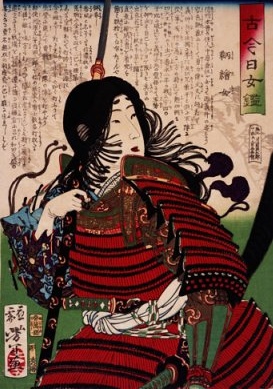
Two words sum up this amazing woman: concubine, warrior. Tomoe Gozen was an extremely rare thing: a female samurai warrior. Here is what a historical account of her says: “Tomoe was especially beautiful, with white skin, long hair, and charming features. She was also a remarkably strong archer, and as a swordswoman she was a warrior worth a thousand, ready to confront a demon or a god, mounted or on foot. She handled unbroken horses with superb skill; she rode unscathed down perilous descents. Whenever a battle was imminent, Yoshinaka sent her out as his first captain, equipped with strong armor, an oversized sword and a mighty bow; and she performed more deeds of valor than any of his other warriors.” High praise indeed for a male dominated nation, in the 13th century. This warrior woman was also a concubine of Minamoto no Yoshinaka, a revered Japanese general. When he was defeated on the battle field, the sexist pig told Tomoe to leave as he would be ashamed to die with a woman. She went on to behead many, slaughter many, and retire to a quiet life as a nun.

Harald Hardrada
1015 – September 25, 1066


Harald was the youngest of Saint King Olaf II of Norway’s three half-brothers, born to Åsta Gudbrandsdatter. After King Cnut killed his brother Saint Olaf (while Harald was a mere 15 years old), he went off to Constantinople and made himself rich. He then took the opportunity to join the most feared mercenary army, (the Byzantine Vanguard) and began working (or rather cleaving) his way through various armies at the paid request of various European kings. Over his lifetime Harald went on to battle anywhere he could – Europe, the Middle East and Jerusalem. He even managed to take a bit of time out to marry Princess Elisabeth of Russia.

Eventually, Harald became the King of Norway (after the young illegitimate King Magnus mysteriously died). Not being content to rule just one country, he spent years trying to conquer Denmark (much to everyone’s annoyance – in Denmark and in Norway). He finally decided to put his energies elsewhere, which was to be his downfall, but the main reason that history remembers him – he decided to conquer England. Alas, his attempts to take England failed and his army was smashed by that of King Harold Godwinson. Harald was the last great Viking king of Norway, and his invasion of England, and death at the Battle of Stamford Bridge in 1066, marked the end of the Viking age and beginning of the High Middle Ages.

Ulf The Quarrelsome
11th Century AD


Ulf (which means wolf) the Quarrelsome was a brutal Irish Warrior and brother of High King Brian Boru (pictured above). He despised the vikings because they murdered his mother while he was young. While King Brian made a name for himself by uniting Ireland, Ulf made a name for himself by whacking people over the head with a giant battle axe. The union of Ireland put an end to the Scandinavian power over the nation of small states and kingdoms, but some people weren’t too keen about the new state of affairs and they rebelled – with the help of thousands of vikings. It was the famous Battle of Clontarf, in 1014, that Ulf really showed his badassness.

After almost singlehandedly destroying the viking rebels, Ulf came upon Bróðir of Man – one of the nastiest vikings around (and a sorcerer to boot). Here is Njals saga’s account of how Ulf ended the life of Bróðir – in revenge for killing his brother, King Brian: “Ulf the Quarrelsome cut open his belly, and led him round and round the trunk of a tree, and so wound all his entrails out of him, and he did not die before they were all drawn out of him.”

The Surena
84–52 BC


The Surena (a general) was born into the Surena family who had, for generations, protected the Kings of Parthia (found in Modern day Iran), but it was the general who cemented the family name in the books of history. By all accounts he was the hottest guy in town, the strongest, the manliest and the deadliest – and was obviously such a badass that he is known only as THE Surena. When King Hydrodes was overthrown and expelled from Parthia, the Surena led the mission to recapture the Kingdom. He also had a huge harem of concubines, which took two hundred wagons to transport, that travelled with him everywhere – including on military campaigns.

When Crassus stupidly decided to take over the Parthian Empire at the battle of Carrhae, he was brutally put down in one of the most embarrassing trounces of the Roman Army ever, by the Surena and his men. When offered the chance to surrender, Crassus told his men to flee and consequently sent them all to their deaths as the Surena chased them down and killed the lot of them. Crassus was personally beheaded by the Surena and had molten gold poured down his neck. Oh – and did I mention that the Surena was a cross-dresser? Well, not quite, but this is what Plutarch said of him: “[He was] the tallest and finest looking man himself, but the delicacy of his looks and effeminacy of his dress did not promise so much manhood as he really was master of; or his face was painted, and his hair parted after the fashion of the Medes.”

Chandragupta Maurya
340 BC – 298 BC


Chandragupta Maurya, born in Bihar, Eastern India, was an orphaned commoner who changed the face of India and forever altered its history, by clawing his way from the slums to forging one of the most expansive Empires in India’s history. Not only did he command nine thousand war elephants, fifty million people and an army of thirty-six thousand – he also had one of the most badass (and awesome) bodyguard units ever. His personal bodyguard unit was made of up more than five hundred Greek and Indian warrior women. In order to destroy the Nanda empire, Maurya simply grabbed a bronze sword and singlehandedly stormed the palace. He was captured and jailed, but escaped – further cementing his place in history as a badass. Ultimately, he went on to destroy the ruling dynasty and put into place the long lasting Maurya dynasty.

Great Philanthropists Who Are Kids

Fortunately, it’s easy to get out of this frame of mind and back to reality. There are some great kids out there doing some great things.

How could they not be? They’re bombarded by influences seemingly determined to rob them of all innocence and feeling for their fellow man.

Better U


Someday a better writer will make a new list of young philanthropists, and I wouldn’t be surprised if the kids on it were involved with the Be Better U Dream Ranch, which helps children learn and teach other kids about philanthropy. If you or your child are in the Dallas-Fort Worth area, and are interested in child-led philanthropy programs, go to their website and see if you’d like to help out.

Harry Moseley


Harry Moseley is a nine-year-old from Sheldon, Birmingham, UK. He lives with an inoperable brain tumor, but this hasn’t stopped him from making and selling beaded bracelets for Brain Tumour UK. His bracelets are now available in over 30 shops across Britain, and so far he’s raised over £15,000.

Harry also gives PowerPoint presentations to school kids, and encourages them to set up bracelet making clubs. Harry’s system gives 15p from every bracelet sold to the kids’ school and the rest goes to Brain Tumour UK. Harry started his fundraising efforts after an elderly friend in the hospital bed next to him died from their shared condition.

When presented with the 2010 ‘Britain’s Kindest Kid’ award, reports say Harry was “speechless” and “gobsmacked”. He plans to give £200 each to his brother and sister and spend the rest on a wooden playhouse in the garden where he can make bracelets. He dedicated his prize to his late friend Robert Harley.

Zach Bonner


After hurricane Charlie hit Florida in 2005, Zach Bonner collected water bottles in his neighborhood using a little red wagon. By the end of the charity drive, he had 27 truckloads of aid. And he was just getting started.

In 2007, Zach began a three-stage “My House to the White House” charity march, to raise money for homeless children. In Stage 1, he walked 280 miles from Tampa to Tallahassee, Florida. In stage 2, he walked 250 miles from Tallahassee to Atlanta, Georgia. In the last leg of the trip, he walked 668 miles from Atlanta to Washington, DC. His most serious test came when his grandmother died, and the 11-year-old was forced to choose between finishing the walk or attending her funeral. He continued the trek and dedicated the march in her honor. All monies were split between a playground for an emergency foster care shelter in Tampa, and the Sasha Bruce Youthwork, which helps runaways and homeless kids in Washington, DC.
In 2010 Zach’s ‘March Across America” took him 2,448 miles from Tampa to Los Angeles, culminating in a meeting with Elton John, who contributed $25,000 to the Little Red Wagon Foundation.

Timothy Hwang and Minsoo Han


In 2007, Timothy Hwang and Minsoo Han started Operation Fly, when they were only 14 years old. Their non-profit business offers cut-rate tutoring services to inner city students, and then uses the revenues to distribute blankets, clothing and soap to Washington DC’s homeless. Their organization has since spread to five cities, involves over 800 volunteers and is entirely student-run. For his efforts, Ernst & Young and Junior Achievement named Timothy Hwang the 2009 Youth Entrepreneur of the Year for the Greater Washington Region.

Mackenzie Bearup


Mackenzie Bearup is a 16-year-old girl with Reflex Sympathetic Dystrophy, a medical condition that makes cold weather, wind and vibrations excruciatingly painful. She found relief in books, and reads constantly. Then she learned of a residential treatment center that needed books for its library, and began soliciting donations. Mackenzie’s book drives have since donated over 50,000 books to treatment centers in Georgia and neighboring states, and Nestle gave her their 2009 ‘Best in Youth’ award.

Her altruism appears to be a good tonic as well: since starting her volunteer work, Mackenzie has maintained a 4.0 GPA in gifted and talented classes. She also plays harp in an orchestra, and has performed at charity events, assisted living facilities, and nursing homes.

Brittany and Robbie Berquist


Brittany and Robbie Bergquist (12 and 13, respectively) learned of a soldier who racked up an $8000 cell phone bill by calling his family from Iraq. They decided to pay the soldier’s phone bill and brought $21 to the bank to start an account. The bank manager was so impressed he added an additional $500. This encouraged them to keep trying.

The kids then held car washes and bake sales, but then decided on recycling used cell phones. With help from volunteers, they set up drop-off sites across the USA, and used the proceeds to buy prepaid phone cards for troops overseas. To date their ‘Cell Phones for Soldiers” program has collected 7.5 million phones and provided military personnel with over 90 million minutes’ worth of pre-paid airtime.

Phoebe Russell


5-year-old Phoebe Russell needed to complete a community service project before she could graduate from kindergarten. Uninterested in a lemonade stand, she saw a homeless man begging for food and decided to raise $1,000 for the San Francisco Food Bank. Her teacher tried to lower expectations to something more reasonable, but Phoebe’s heartwarming appeal to leave soda cans and donations at the school snowballed. Before she knew it, Phoebe had raised $3,736.30– the equivalent of 17,800 heated meals.

Jordan Somer


Jordan Somer is a Nebraska teen who founded the “Miss Amazing” pageant, an event for girls and women coping with physical and mental disabilities. The event focuses on all participants gaining confidence and revealing their true beauty. Jordan started the event in 2006, as a way to combine her own pageant experience with her Special Olympics volunteer work. Jordan recently received Teen Nickelodeon’s Halo Award, and hopes to use the $25,000 grant to expand the pageant nationally.

Cameron Cohen


Cameron Cohen was 11-years old when he was stuck at home with a hip-to-toe brace following bone tumor surgery. Instead of playing Halo or watching Spongebob, Cameron spent his downtime learning software development. He then used his mad skillz to design ‘iSketch’, a drawing program now available on the iPhone App Store. Cameron donates a portion of his earnings to purchase electronic and entertainment items for other pre-teens to enjoy during their hospitalization.

Olivia Bouler


Olivia Bouler is an 11-year-old artist who has raised over $200,000 for the National Audubon Society, which is hard at work rescuing birds affected by the BP oil spill in the Gulf of Mexico.

It all started when Olivia saw the oil spill on TV. Not knowing how to help, she wrote a letter to the Audubon Society, offering to sell her illustrations to raise money for cleanup costs. Then she hit upon the idea of just giving her drawings to anyone who donated to wildlife recovery efforts. Media outlets caught wind of her offer and the donations came flooding in. She’s made 150 illustrations so far, and shows no signs of stopping.

Abby Miller


Abby Miller is a 12-year-old musician who collects donations for 4-year-old Taylor Love, who suffers from neuroblastoma, a form of cancer affecting the nervous system. Most contributions come the old fashioned way– from playing on the street with a contribution bucket nearby. All funds go to help Taylor’s family with medical expenses. Passersby typically note Abby’s talent and drop in a few bucks, wondering why a young kid would be singing in the street on a cold day. Few notice she’s singing for a cause greater than herself.